Inside a Small-Scale Koji Workshop in Japan
Updated: May 14
In March 2026, I was given the opportunity to do an internship at Miyamoto Koji-ten in Nishio City, Aichi Prefecture, Japan. This is my report about the 11 day experience.

table of contents
About Miyamoto Koji-ten
Aichi Prefecture is located roughly in the middle of Japan's main island on the pacific side, about halfway between Tokyo and Osaka along the coast. It's part of the "Umami capital" of Japan, which has been a centre for fermentation and brewing industries for at least a few hundred years.
Miyamoto Koji-ten (ten means "shop") is a small, venture-style koji producer that opened in 2016. Founded by Takashi Miyamoto, who comes from a farming background. The shop focuses on working closely with local ingredients, including produce from his own farm.
They specialise in small-batch, diverse koji making, alongside hands-on workshops such as miso and soy sauce making. The guiding philosophy behind the business is a simple but heartfelt wish: to enrich the everyday food of families and help bring more depth, enjoyment, and connection to what people eat.
I make and sell koji in the UK and also share information about fermentation using koji.
In order to share accurate information, I've read countless books, done extensive research online, and joined classes and fermentation-related communities. Still, I'd always had one thought in the back of my mind: I want to see a real production site with my own eyes! (My main profession is designing electrical products, and in manufacturing, visiting 'Gemba' is one of the most basic and important things.)
That's when I came across an Instagram post advertising an internship at koji production.
*As of today (12th May 2026), applicants must be able to speak or understand Japanese, although they are planning to introduce programmes in English in the future. Worth keeping an eye on it!
What the Internship Involved
The work probably changes depending on the season, but these are the tasks I experienced during my stay.
Koji making
The basic rice koji production schedule looked like this:
Day 1: (evening) washing and soaking the rice
Day 2: (morning) preparation, steaming, inoculating with koji spores, (evening) mixing
Day 3: mixing in the morning and evening depending on the condition
Day 4: (morning) finishing the koji, drying it, and cleaning the equipment
(For detailed instructions on how to make koji in general, click here -> How to make rice koji )
Usually there was one task in the morning, plus another one or two jobs in the afternoon depending on the type of koji and how long it had been fermenting. Handling large amounts of rice - especially during preparation - was physically demanding, but the koji-making machines controlled temperature with heaters and fans, so it wasn't the sort of environment where someone stay awake all night constantly checking thermometers.
It was truly rewarding to be able to watch experienced staff working with such skill while enjoying the aroma of freshly made koji.

The steamed rice is being cooled. There's so much steam that you can't see anything around!

Finishing black koji. Since black koji releases spores, we wear masks while working.
Labelling and packaging
Our tasks included labelling bags and containers, weighing and packaging products.
You could quietly focus on the work, or chat together while keeping your hands busy. It was an eye-opener to see labels you normally take for granted from a different perspective. Personally, I loved thinking about how to do it faster, more organised and efficient.
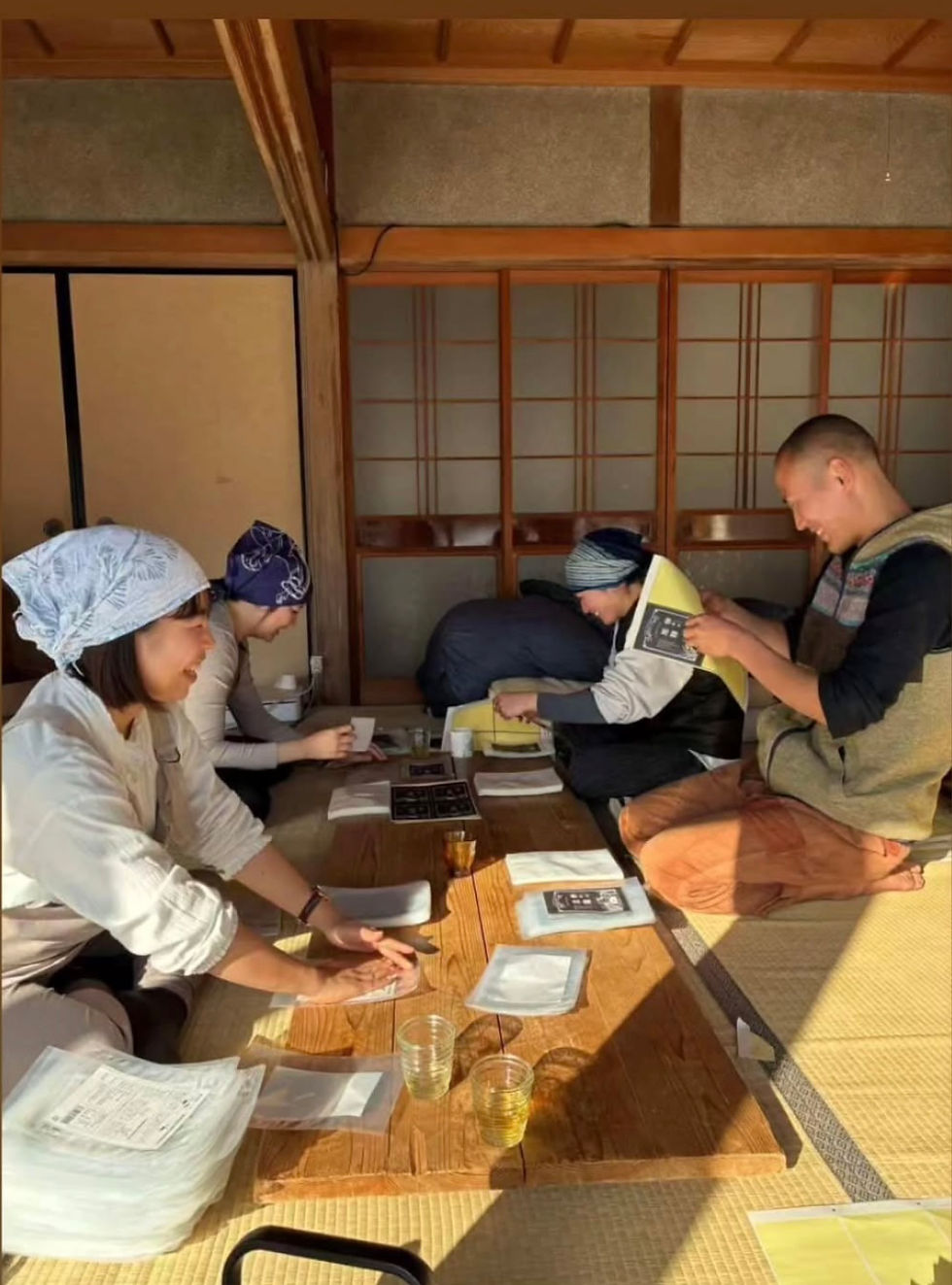
Time flies when you're chatting while labeling, and before you know it, you've got a mountain of finished packages!
Miso-making workshop
Their miso-making workshops, which take place from January to April each year, are incredibly popular. They are fully booked every year and attract many repeat participants.
On workshop days, we spend the morning preparing ingredients and setting up equipment. After an early lunch, there would usually be two miso workshops in the afternoon, sometimes a soy sauce workshop as well, followed by cleaning up.
During the workshops, we helped guide participants, assisted staff members, and sometimes played with children who had come along with their families.
At Miyamoto Koji-ten's workshops, you can make 8kg or 12kg of miso in just one hour! This sounds like a lot, but if a family of four has miso soup every day, they will require about 6 kg of miso a year. You can also use miso in various other dishes.
The procedure is quite efficient. First, the pre-boiled soybeans are minced and mixed with pre-weighed koji and salt in large wooden tubs. Then, the mixture is transferred into containers prepared by the participants. Some experienced attendees finished in only 30 minutes.
If you were to prepare all the ingredients at home, boil huge quantities of soybeans, and mash them by hand, it could easily take all day. But using professional equipment at the shop transforms it into a fun annual outing with family, friends, or simply for yourself.
According to Takashi, the workshop style has been evolving over the past twenty years depending on circumstances such as COVID, as well as making things easier and more enjoyable for both customers and staff. This current format is what they settled on for now.

The workshop takes place in a tatami room with big, wide-opening doors/windows. It's especially pleasant on beautiful days.

I made my own miso too! It's always good to get your hands dirty and understand what you're actually eating.
Cleaning the tofu shop
I also helped clean a former tofu shop that is being renovated and prepared to reopen as "Tofu Miyamoto" under the same ownership as Koji-ten.
The Koji-ten staff were all incredibly handy people, doing as much of the renovation work themselves as possible, including sanding and painting parts of the building. I polished the tofu display cases and walls.
The previous tofu shop owner also stopped by occasionally and shared stories about his tofu making with us. I never expected that an internship at a koji shop would also teach me about tofu, so that was a wonderful surprise.
Soy sauce and Mirin Brewery tour
While I was there, fortunately, I was allowed to tag along on a brewery tour. It was an incredibly valuable opportunity!
Nitto Jozo Co., Ltd.
We visited a rare white soy sauce brewery that makes various seasonings, including "Shirotamari," a sauce made from 100% wheat koji.
It was my first time trying Shirotamari, and I found it very different from typical soy sauce; it's rich in umami but it has much more delicate flavour that isn't too overpowering. It seems like it would work well not only in Japanese cuisine, but in other cuisines too.

Tanks of white soy sauce lined up in a temperature-controlled room.
Kakutani Bunjiro Shoten
Kakutani Bunjiro Shoten is a mirin brewery founded in 1910. Not only did we get a tour of the brewery, but we also learned a lot about the origins of mirin including the fact that it began as a drink, which I found very interesting. I also make mirin for myself, but the ratio of solid to liquid ingredients in their recipe was completely different.
One of the few authentic mirin available in the UK is made here.

The glutinous rice has just come out of the steamer. The ingredients are mixed here before being transferred to a tank for ageing.

A Koji-ten staff Mirco and Lino from ONRI FERMENTS. The locally caught fish was utterly delicious!
Daily life at Miyamoto Koji-ten
Accommodation and meals are provided throughout the internship. The owner's family, some members of staff and interns all live together on the premises of the Koji-ten, sharing day-to-day life in the same space.
A typical day during my stay looked something like this:
7:30 — Breakfast (for those who want to eat)
8:45 — Morning radio exercises, then start work
Around 11:30 — Prepare lunch, eat together
Around 13:00 — Afternoon work
Around 17:00–18:00 — Finish work, prepare dinner, eat together
Around 20:00 — have shower in turns, then free time to drink, relax or sleep
Apart from the morning routine, everything was incredibly flexible. Some days we went out for pizza at lunchtime; other days we finished early and went to Nagoya to watch a basketball game. Every day was fresh and the 11 days flew by.
It had been a long time since I regularly shared three meals a day while chatting with other people, and it was very stimulating to get to know each other so well in an environment where interns and staff are constantly coming and going.
Even while working, the atmosphere was warm and relaxed rather than silent and rigid. It really felt like a community built around people. After experiencing it myself, I completely understand why so many interns return again and again.

A night filled with laughter, at a local Izakaya (Pub/Restaurant)
Things I Learned and Reflected On
・The people are wonderful
It's hard to put into words, but Takashi and his family, the staff, and the interns all have incredibly diverse backgrounds, making conversations fascinating. I was also struck by their amazing ability to accept others as they are while remaining true to themselves. Perhaps this is why such lovely people keep coming together.
There was also a really comfortable balance in the atmosphere — people took their work seriously, but it never felt like they were sacrificing their lives for work. They love the life they live, live the life they love. (That may just be my personal interpretation though)
One thing that especially stayed with me was how conversations gradually changed my thinking. There were several moments where ideas I had always believed "had to be done a certain way" suddenly became "actually, maybe they don't."
For example, when someone asked why I moved to the UK, I explained that pursuing my dream job was the main reason, but also that I'd once visited the UK with my family as a child and regretted barely being able to communicate with local people. Their response was "You're very diligent, aren't you?"
That reaction genuinely shocked me because it had never occurred to me to see it that way. In that moment, I realised I had been the one setting high standard for myself and disappointed myself almost unecessarily.
Also, through my internships and visits, I learnt that in the worlds of koji and brewing, there is no single 'correct' way of doing things. In fact, everyone uses their own unique methods to bring wonderful products to market.
I want to continue cherishing the lessons I have learnt here and the connections and relationships with the people I met here.

A few final thoughts, briefly:
I enjoy working while being physically active.
Instagram Stories should be posted casually and without overthinking
Building relationships with local people and others in the industry is incredibly important
Flexibility matters in everything
I'm really pleased that I took the plunge and went for it.
Thank you so much to all the members of Koji-ten, the interns, everyone I met there, and everyone who read this report.

Miyamoto Koji-ten website: https://miyamotokojiten.com/
